










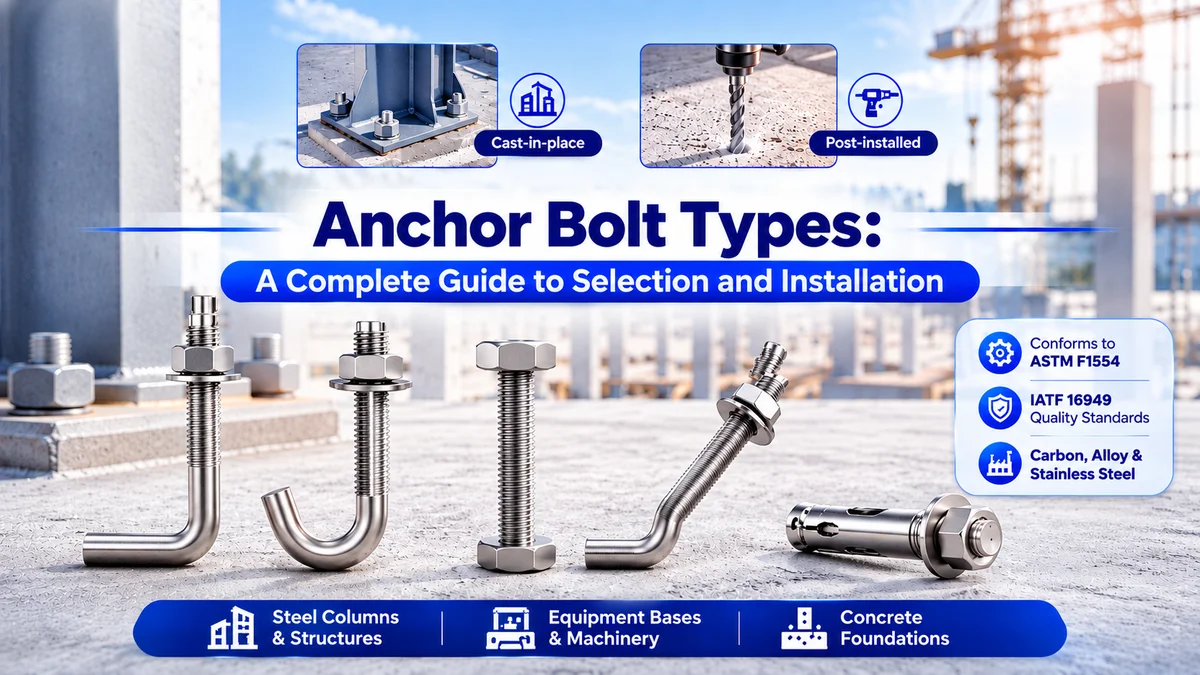
anchor bolts connect structural components like steel columns, equipment bases, and machinery to concrete foundations. The main types are L-bolts, J-bolts, headed bolts, bent bolts, and sleeve anchors, each suited to different load types, base materials, and installation timing. Choosing the wrong type can lead to structural failure, so selection should follow ASTM F1554 standards and engineering specifications. CNXD manufactures custom anchor bolts in carbon, alloy, and stainless steel under IATF 16949 quality standards.
What is an Anchor Bolt?
An anchor bolt is a threaded fastener that locks into concrete or masonry to hold down the structure above it.
What sets these apart from standard bolts is that it locks straight into the foundation. These bolts create a permanent, solid attachment point for surface-mounted structures.
Standard bolts, in comparison, are used to clamp two separate loose parts together.
You can install anchor bolts in two ways:
Cast-in-place: Setting the bolts in place using templates before pouring concrete to ensure that they land exactly as the engineering plan lays out.
Post-installed: Bolts are connected into holes by drilling into solid, hardened concrete.
These methods work well depending on the intended application.
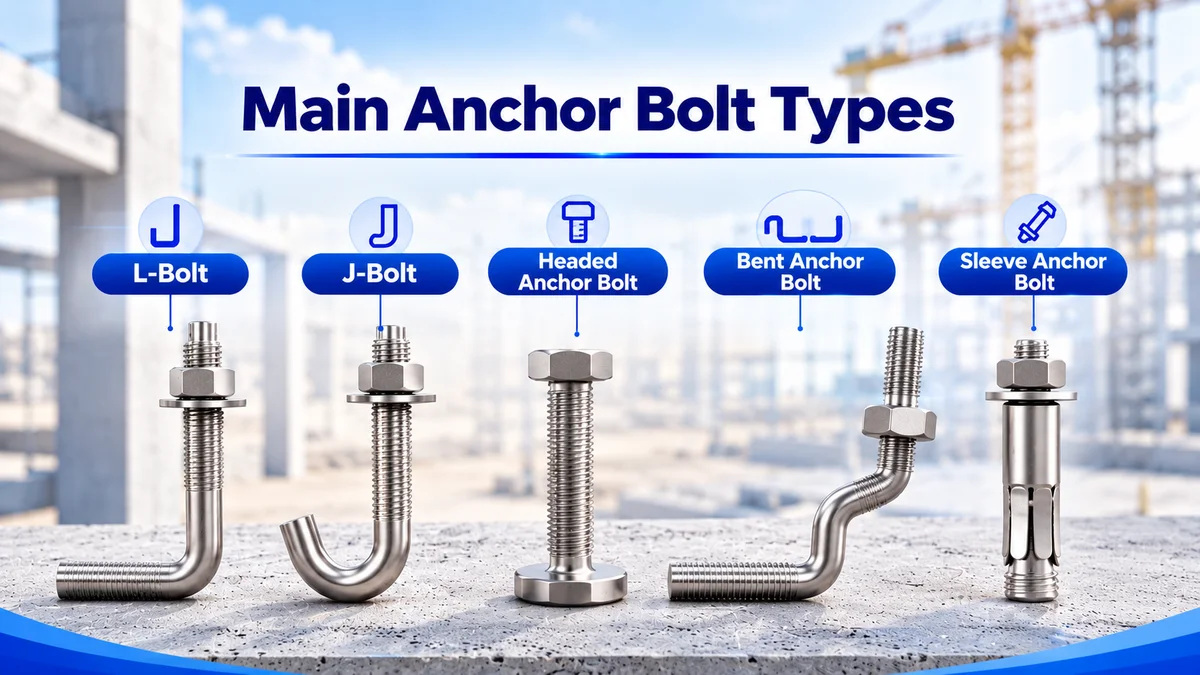
Main anchor bolt types
| Type | Main Feature | Functions | Best Application |
|---|---|---|---|
| L-Bolt | 90-degree bend at the bottom | Grips the surrounding concrete to resist vertical pullout | Structural steel column bases and heavy equipment mounts that require 12-14 inches in depth |
| J-Bolt | Curved, J-shaped hook | Used to secure or connect light materials | Wood sill plates, utility poles, and street signages |
| Headed Anchor Bolt | Standard hex head or a welded plate at the bottom | Spreads tensile loads across a wide area inside the concrete | Heavy industrial foundations that need high strengths without digging deep holes |
| Bent Anchor Bolt | Used as an umbrella term that includes L-bolts, J-bolts, double-bend bolts, and U-bolts | Used to connect or secure areas or structures with various shapes | Pipe connections that support multiple angles |
| Sleeve Anchor Bolt | Used for pre-drilled hardened concrete | Used to attach fixtures to existing buildings; for repairs and maintenance | Retrofit projects, such as strengthening existing buildings or structures (bridges, steel bracing, etc.) |
Different types are used for different purposes. So, here are the common types of anchor bolts to familiarize yourself with.
Materials and Standards
| Material | Grade | Typical Use |
|---|---|---|
| Low carbon steel | F1554 Grade 36 | Light structural steel for general construction |
| Medium carbon steel | F1554 Grade 55 | Structural framing with moderate load |
| High-strength steel | F1554 Grade 105 | Heavy structural loads |
| Stainless steel | 304/316 | Corrosive applications; coastal projects |
| Galvanized steel | Hot-dip (ASTM A153) | Outdoor structures |
The material you choose determines how long your bolts will last and how much weight they can hold.
In North America, ASTM F1554 sets the standard for anchor bolts that are used for standard structural projects. It typically defines the following for Grades 36, 55, and 105:
- tensile strength.
- yield strength.
- Elongation.
- Weldability.
Pro Tip: Projects involving saltwater, chemical, or wastewater exposure, stainless or galvanized steel to avoid surface rusting.
How to Choose the Right Anchor Bolt
Here are the critical considerations in selecting the appropriate hardware:
1. Direction of Applied Force
- Pullout (Tensile) loads: Select headed anchor bolts.
- Side-to-Side (Shear) loads: Select straight or slight bend forms.
- Combined Loads: Determine their interaction effect before selecting.
2. Base Material: Stronger concrete gives the bolt better anchorage strength. Engineers apply ACI 318 calculations in such cases.
3. Exposure: hot-dip galvanized or Stainless steel are recommended in environments that expose the installation to water; Plain carbon steel should be selected in dry interiors.
4. Construction Phase: In case of freshly poured concrete, cast in-place L-bolts and J-bolts provide the most efficient and economical anchorage; in case of hardened concrete, post-installed expansion or chemical adhesives are the only choices.
Best Practices for Installation
These few installation steps are crucial in ensuring the successful installation of anchor bolts. The following are some of the most ignored installation recommendations that you should consider for your knowledge.
1. Use Templates
Make templates of the same bolt pattern that is indicated on your drawing designs. The templates will hold the bolts in place while pouring the concrete to the intended location.
2. Use Specified Embedments Depths
embedments depths are directly proportional to the pullout resistance. Nevertheless, it is recommended to adhere to the engineering drawing in order to save time, effort, money, and other resources.
3. Tightening and Testing
After hardening the concrete, you should tighten the bolts to the specified torque using the calibrated torque wrench. Proof-load testing is also necessary for critical structures and seismic regions.
Anchor bolts vs Expansion Anchors: Which Do You Need?
| Feature | Cast-in anchor bolts | expansion anchors |
|---|---|---|
| Installation Timing | Installed before pouring fresh concrete | Drilled into hardened concrete |
| Holding Power | Mechanical interlock with cured concrete | Friction against the drilled hole wall |
| Best For | New construction; heavy structural loads | Retrofits, repairs, and add-ons |
| Cost Efficiency | Higher load capacity per dollar | Fast installation for existing structures |
Need Custom Hardware?
CNXD offers custom manufacturing of anchor bolts in carbon, alloy, and stainless steel under IATF 16949 quality standards. If your project needs non-standard dimensions or specific material grades, contact us immediately.
Anchor bolt types: Frequently Asked Questions
What is an anchor bolt?
An anchor bolt is an essential fastener that secures the structure directly into the concrete foundation. You will find these bolts supporting the structural columns, industrial machinery, street lights, utility poles, and precast concrete walls.
What is the difference between L-bolt and J-bolt?
The main characteristic of L-bolts is the sharp hook in the angle of 90 degrees; thus, it can withstand the load very well in order to support the structural frame column. The J-bolts come in a small curved hook and are used for small loads such as sill plates and lightweight utility equipment.
What grade of anchor bolt should I use for structural steel?
ASTM F1554 Grade 36 handles most light to moderate structural jobs. Engineers specify Grade 55 or Grade 105 when dealing with heavy loads or when space limitations require a smaller bolt diameter with higher yield strength. Always follow the engineer’s specifications on your drawing set.