










Quick Answer
Classify automotive fasteners by function and installation position first. Wheel-end parts demand strict control of seat style, pitch, thread engagement, and coating. A standardized RFQ with these specs reduces mis-picks and returns. CNXD maintains a stock of over 30,000 fastener types, including wheel bolts, lug nuts, and camber bolts, to support production continuity and aftermarket needs.
Fasteners are small parts with big consequences. They control clamp load, vibration resistance, corrosion performance, and whether a repair job is clean or turns into stripped threads, noisy panels, and warranty claims. For B2B buyers, the real challenge is not “finding a bolt,” but building a consistent spec system that works across platforms, kits, and service environments.
This article explains automotive fastener types using the same approach procurement teams use in the field: classify by function, then map to vehicle installation positions. Since CNXD centers its offering on wheel-system hardware, especially wheel bolts, lug nuts, and camber bolts, you’ll also see wheel-end examples linked directly from the CNXD catalog so you can cross-check formats and categories quickly.
How Buyers Should Classify Fasteners
A strong purchasing framework uses three layers. When these are written clearly in your RFQ, quoting becomes faster and substitutions become less risky, especially when you’re comparing automotive fastener types across multiple vehicle lines.
By function
- Clamp and hold (threaded joints)
- Retain and locate (clips, retainers, quick nuts)
- Create threads in thin material (anchors, inserts)
- Enable serviceability (repeat removal without damage)
By installation position
- Wheel end (hub/wheel interface)
- Chassis and suspension
- Braking and steering
- Engine bay and powertrain
- Body, trim, and interior
By spec and verification method
- Define the standard, strength class, coating, and inspection plan. If you’re building sourcing standards and want a clearer view of factory controls, documentation, and QC checkpoints, reference: OEM Fastener Manufacturing: What Buyers Need to Know. If you need a fast overview of how CNXD presents its manufacturing and process positioning, use the internal pages for Automotive Fastening Solutions and Automotive Aftermarket Fastener Solutions to align terminology with its catalog structure.
Wheel System Fasteners (CNXD Core Focus)
Wheel-end retention has less tolerance for “close enough.” One wrong seat style or pitch can create loose wheels, damaged hubs, or repeat returns. That’s why many brands organize their wheel programs first, then build outward into the rest of the vehicle. In wheel programs, automotive fastener types are most often evaluated around seating geometry, thread engagement, and predictable torque behavior.
1. Wheel bolts and lug bolts
Vehicles that thread directly into the hub rely on wheel bolts/lug bolts to generate clamp load without studs. If your audience is unsure which wheel-end setup they’re dealing with, a quick comparison can prevent fitment mistakes and returns: Wheel Fasteners: Lug Bolts vs Lug Nuts. Buyers commonly compare types of wheel bolts by:
- Seat style (ball vs conical, application-dependent)
- Shank length and thread engagement
- Strength class and coating consistency
To browse the category quickly, use Lug Bolts. For a concrete part reference, CNXD lists a heavy-duty application example in Automobile Wheel Bolt 10.9 for MAZ 5335-3101040.


2. Lug nuts
Stud-and-nut wheel systems are common across passenger and commercial vehicles. When teams talk about different types of wheel nuts, they’re typically choosing between open-end vs closed-end designs, flange styles, and special drives for theft resistance or packaging constraints. You can explore CNXD’s range of lug nuts and view one example format at Car Alloy Silver Wheel Lug Nuts (35mm).
3. Camber and alignment bolts
Alignment correction hardware is often purchased alongside wheel-end SKUs because it solves the real customer pain: steering pull, tire wear, or a suspension change that knocks geometry out of spec. For buyers who need to explain alignment correction to installers or customers in plain language, this short guide helps: What Are Camber Bolts and How Do They Work? CNXD groups these parts under eccentric camber bolts. If you need a specific reference for fitment-style listing, see Camber Bolt Kit for Mercedes-Benz W212 / CLS-Class (0003331071).
Chassis and Suspension Fasteners
Suspension joints live in water spray, grit, road salt, and constant cyclic load. That environment makes “same thread, same length” substitutions risky. When sourcing automotive fastener types for chassis work, always separate bolts that provide clamp load from bolts that also locate components through precision shanks.
1. Suspension bolts
Common chassis fasteners include control arm bolts, subframe bolts, stabilizer link bolts, and mounting hardware for brackets. These parts often require:
- High-strength class for fatigue resistance
- Stable coating for corrosion life
- Defined torque procedure (including torque-angle in some cases)
2. Nuts, washers, and locking strategy
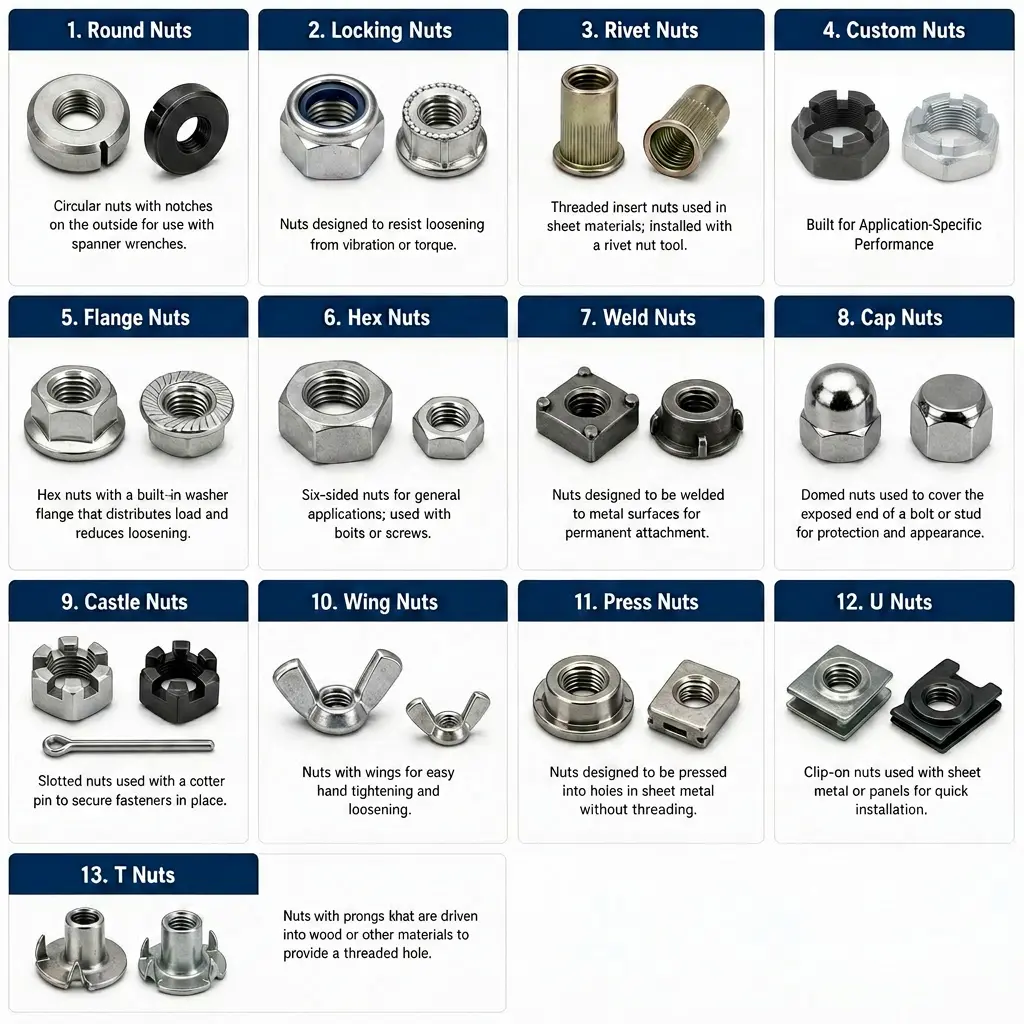
Your locking strategy should match service reality. Some joints are serviced frequently; others are meant to stay untouched for years. In B2B kits and catalog planning, it helps to standardize types of automotive nuts by application family (wheel-end, chassis, trim) rather than treating all nuts as one bucket.
Braking, Steering, and Engine Bay Fasteners

This zone is a mix of tight access, high temperature, and exposure to fluids. For buyers and distributors, errors here typically show up as installation difficulty (wrong drive), damaged coating (wrong tool), or noise/vibration complaints.
1. Braking and steering mounts
Brake and steering hardware must hold torque through thermal cycles and vibration. Focus on:
- Strength class and joint design intent
- Drive style that prevents cam-out
- Coating that holds up in splash zones
If your catalog includes wheel-adjacent assemblies and hub hardware, CNXD also organizes related items under Hub Bolts & Nuts, which can help buyers group wheel-end service parts more cleanly.
2. Engine bay brackets and mounts
In sourcing conversations, people often say types of bolts used in automotive, but that phrase only becomes useful when you define the job: is it a clamp-load joint, a locating joint, or a light bracket retainer? Once the joint intent is clear, your spec becomes clearer (and your returns drop).
Body, Trim, and Interior Retainers
Trim and interior fasteners are a different game: speed, clean removal, and anti-rattle performance matter more than ultimate tensile strength. This is where a smart retention strategy saves labor time and reduces customer complaints.
1. Clips, retainers, and speed nuts
Trim clips, push retainers, and automotive speed nuts are used in fender liners, splash shields, undertrays, and interior panels, especially where you can’t access the backside easily.
2. Screws and anchors for plastics
Interior and body modules commonly use a range of screws and support pieces that spread load in plastics. For sourcing documents, define types of automotive screws by drive style, thread type (self-tapping vs machine), and material pairing. For thin or brittle materials, specifying automotive screw anchors can reduce pull-through and improve reassembly durability.
Materials, Coatings, and Strength Basics
Material and coating choices influence torque scatter, clamp load stability, and corrosion life. Two parts can look identical but behave differently in the field if the coating system changes the friction.
1. Materials used in automotive fasteners
- Carbon/alloy steel for strength and fatigue performance
- Stainless for corrosion resistance (with different torque behavior)
- Specialty alloys for high temperature or unique environments
2. Coatings and verification
Most wheel-end and chassis programs succeed or fail on coating consistency. That’s why many buyers ask for clear documentation and inspection practices when comparing automotive fastener types across automotive fastener suppliers. For the CNXD sourcing context, you can reference the internal pages for Quality Assurance, Certificates, and Our Factory during supplier evaluation.
RFQ Checklist for B2B Programs
A clean RFQ prevents back-and-forth and reduces quoting errors, especially when you’re consolidating wheel-end SKUs and suspension/alignment kits under one program.
What to include in every RFQ
- Vehicle/application and installation position
- Thread spec (diameter, pitch, engagement requirement)
- Head/drive style and seat style (wheel-end)
- Strength class and inspection plan
- Coating requirement and corrosion target
- Packaging expectations (unit packs, kits, labels, barcodes)
How to reduce mis-picks and returns
- Separate wheel-end items by seat style and pitch
- Use clear naming in listings and packaging
- Standardize inspection and traceability requirements
- Build kits around real repair workflows, not just part numbers
When you document this process well, it becomes easier to compare automotive bolt types in a way that reflects real installation differences instead of only thread dimensions.
Why CNXD Wheel-System Focus Helps B2B Buyers
Many aftermarket brands and distributors build their best-performing programs around wheel-end categories first, because that’s where fitment accuracy and safety requirements are highest. CNXD catalog structure supports that workflow by keeping wheel-system hardware easy to find and easy to quote. For quick navigation, start from Products, then move into wheel program categories such as lug nuts and eccentric camber bolts.
Conclusion
The fastest way to make sourcing more reliable is to classify fasteners by function and installation position, then lock the spec details that affect performance: thread engagement, seat geometry, strength class, coating, and verification method. With that structure, you can evaluate automotive fastener types consistently across platforms, reduce returns, and build service kits that installers trust.
For wheel-end programs in particular, CNXD’s focus on wheel bolts, lug nuts, and camber bolts aligns with what the market buys most often, and what requires the tightest control. When your wheel catalog is organized clearly and supported by quality documentation, scaling B2B supply becomes much simpler.
Key Takeaways
- Classify fasteners by function and vehicle position first to prevent wrong substitutions.
- Wheel-end fasteners require strict control of seat type, pitch, engagement, and coating for consistent clamp load.
- A standardized RFQ format reduces quote cycles, mis-picks, and return rates.
FAQs
1) What are the most common fasteners used in vehicles?
Wheel bolts or lug nuts, suspension bolts, trim clips, and general screws are the most common across modern vehicles.
2) How do I choose between lug nuts and wheel bolts?
It depends on the hub design: stud-based hubs use lug nuts, while bolt-to-hub designs use wheel bolts. Always match pitch, seat style, and engagement length to OE requirements.
3) Why are camber bolts often included in suspension kits?
Camber bolts provide controlled adjustability for alignment after suspension repairs or modifications, helping correct tire wear and handling issues.
4) What matters most when sourcing fasteners at scale?
Clear specification, repeatable coating behavior, inspection capability, and packaging/labeling consistency matter more than a one-time sample pass.
5) How should I qualify a new supplier for wheel hardware?
Ask for documentation, traceability, inspection methods, and capability proof. Comparing manufacturing workflows and quality systems across candidates helps reduce risk when onboarding new vendors, especially when your program spans multiple vehicle platforms and regions.