










Carriage bolts suit wood and light structural connections where tamper resistance matters, while hex bolts cover metal-to-metal joints, structural steel, and applications requiring controlled torque from the head. The key difference is the head design. Carriage bolts have a smooth dome with a square neck that locks into wood, while hex bolts have a six-sided head that accepts a wrench from either side. CNXD manufactures both bolt types across SAE and metric standards in carbon steel, alloy steel, and stainless steel, all under IATF 16949 quality management.
What Is a Carriage Bolt? Design and Features
The carriage bolt features a domed, circular head without any driving means. Below the head, there is a square neck that will lock into the fastened material.
This design stops the rotation of the bolt when it is being tightened using the nut on the other side. It is the self-locking principle that characterizes carriage bolts.
The head cannot be gripped or driven by means of a common wrench or screwdriver due to its round shape.
In this way, carriage bolts become tamper-proof from one side of the connection.
Carriage bolts are produced according to the ASME B18.5 standard in imperial sizes and can be found in steel, stainless steel, and hot-dip galvanized finishes.
The standard diameters of carriage bolts range from 3/16 inch up to 3/4 inch, while their lengths are usually available in the range from 3/4 inch to 20 inches.
The thread is always made by a rolling process of the lower part of the shank only.

What Is a Hex Bolt? Design and Features
The head of the hex bolt features six sides, allowing it to be tightened and loosened by wrenching from the outside or with an internal socket drive in certain designs.
The hex bolt, unlike a carriage bolt, can be tightened and loosened from the head end.
The hex bolt is covered by ASME B18.2.1 and ISO 4014 and ISO 4017 standards for imperial and metric screws, respectively, and is offered in a variety of different grades, sizes, and lengths compared to the carriage bolt.
SAE Grade 5 and Grade 8 for inch-series bolts, as well as grades 8.8, 10.9, and 12.9 for metric fasteners, are common strength grades.
The hex head allows applying full torque by means of the standard tools.
Carriage Bolt vs Hex Bolt: Side-by-Side Comparison
| Feature | Carriage Bolt | Hex Bolt |
|---|---|---|
| Head type | Round, smooth dome | Six-sided hex |
| Drive method | Nut only (from opposite side) | Wrench on head or nut |
| Anti-rotation | Square neck embeds into material | Wrench holds head during tightening |
| Tamper resistance | High (smooth head) | Low (head is grippable) |
| Primary material | Wood, light structural | Metal, structural steel, machinery |
| Grade availability | Limited (SAE Grade 2, 5) | Wide range (up to Grade 8 / 12.9) |
| Standard | ASME B18.5 | ASME B18.2.1, ISO 4014/4017 |
The carriage bolt vs hex bolt decision largely depends on two factors: the base material and whether the joint needs access from both sides.
Strength and Load-Bearing Differences
Hex bolts are normally stronger than carriage bolts. Grade 8 hex bolts have a minimum tensile strength of 150,000 psi. Grade 5 has a minimum tensile strength of 120,000 psi.
The most common grades of carriage bolts are grade 2 and grade 5, with grade 2 having a minimum tensile strength of 74,000 psi.
Hex bolts in Grade 8 or its equivalent metric grades are normally used for structural steel assemblies, machinery mounting, and heavy-load joints.
Carriage bolts are normally recommended for timber-to-timber joints, deck assemblies, and light structural assemblies.
The only thing is that the square head of the carriage bolt helps to resist shearing forces in wood joints.
When installed correctly, the head is pressed against the wood, and it helps to resist any lateral loads.
Installation Differences
Carriage bolts need access to just one side of the joint during installation.
The bolts go through the pre-drilled hole; the square part of the bolt neck engages and gets pulled into the wood as the nut is tightened, and installation is finished.
Installation of a nut-side washer is common for preventing the nut from getting pulled through soft materials.
Hex bolts usually need access to two sides of the joint when tightened; one tool grips the head of the bolt while another tightens the nut.
Alternatively, the bolt is tightened using one tool in through-bolt applications where the head is restrained.
In limited-access scenarios, carriage bolts are preferred by most users.
When high torque is involved, hex bolts offer more precision during installation.
Best Applications for Each Bolt Type
Where carriage bolts Work Best
Carriage bolt uses are concentrated in wood construction and outdoor structures.
Deck framing, timber frame connections, playground equipment, fencing, and wooden gates are all common applications.
The smooth head sits flush and clean on the surface. That makes carriage bolts a preferred choice where aesthetics matter on exposed woodwork.
The tamper-resistant head is also useful in public installations.
Benches, signage, and outdoor furniture in public spaces benefit from the one-sided design. The smooth head offers no purchase for unauthorized removal.
Where hex bolts Work Best
Hex bolts cover a broader range of applications. Structural steel connections, equipment bases, automotive assemblies, and industrial machinery all rely on hex bolts.
The ability to apply torque from the head gives hex bolts a clear advantage where clamp load needs to be controlled or verified.
For metal-to-metal joints, hex bolts are almost always the correct choice.
Carriage bolts have no anti-rotation mechanism in metal, so the square neck cannot embed, and the bolt spins freely during tightening.

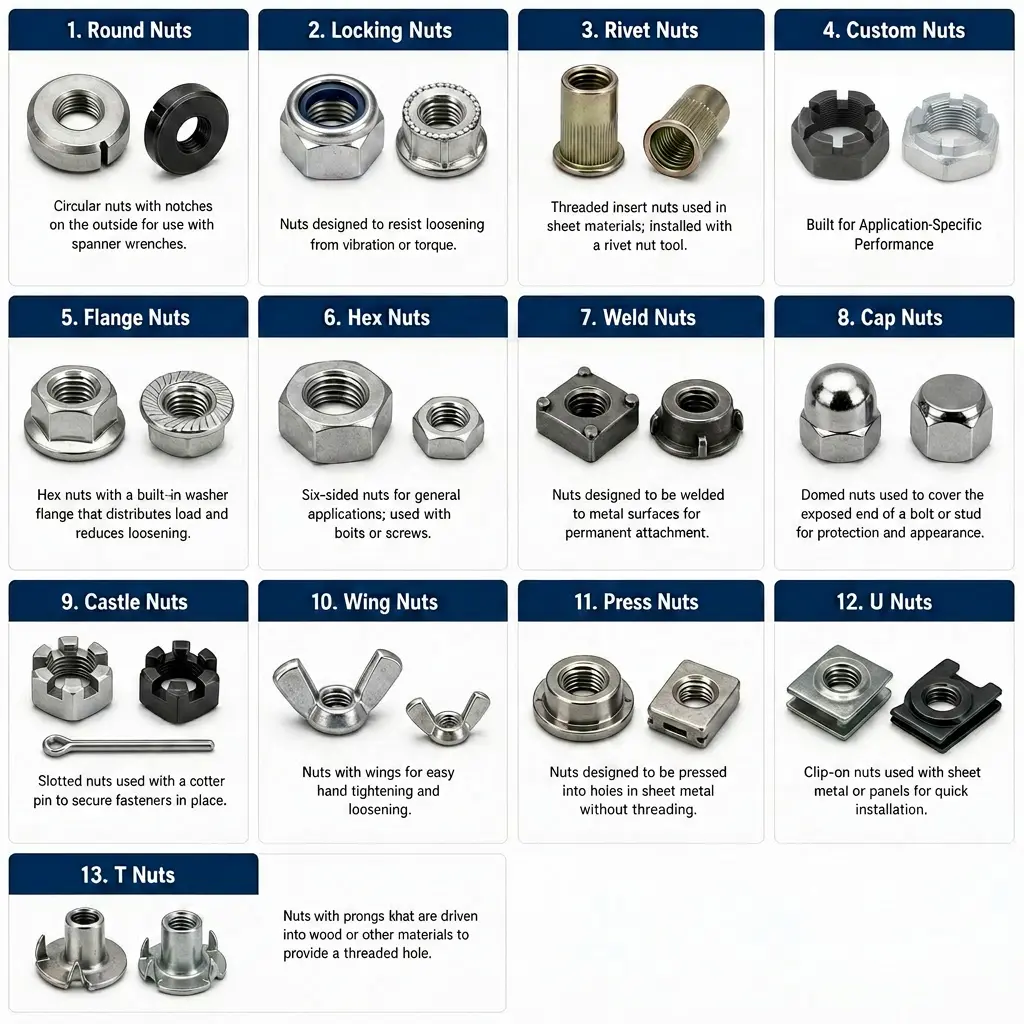
- DIN933 A2-70 stainless steel hexagon bolts are manufactured from premium SS304 material, offering outstanding mechanical properties and corrosion resistance.
FAQs: Can a Carriage Bolt Be Used Instead of a Hex Bolt?
In wood applications, substituting a carriage bolt for a hex bolt is often feasible if the load requirements fall within the carriage bolt’s grade range.
The opposite substitution is also possible, but it requires the installer to hold the head during tightening.
In metal-to-metal applications, carriage bolts are not a suitable substitute for hex bolts. The square neck provides no anti-rotation function in metal, making installation impractical without modification.
For structural applications governed by building codes or engineering specifications, substitutions should always be confirmed against the design documents.
Changing fastener type without engineering review can affect load capacity and code compliance.
CNXD manufactures both carriage bolts and hex bolts across SAE and metric standards, with carbon steel, alloy steel, and stainless steel options.
All products are produced under IATF 16949 quality management with full dimensional and material traceability. Contact CNXD for OEM fastener supply and custom specifications.