










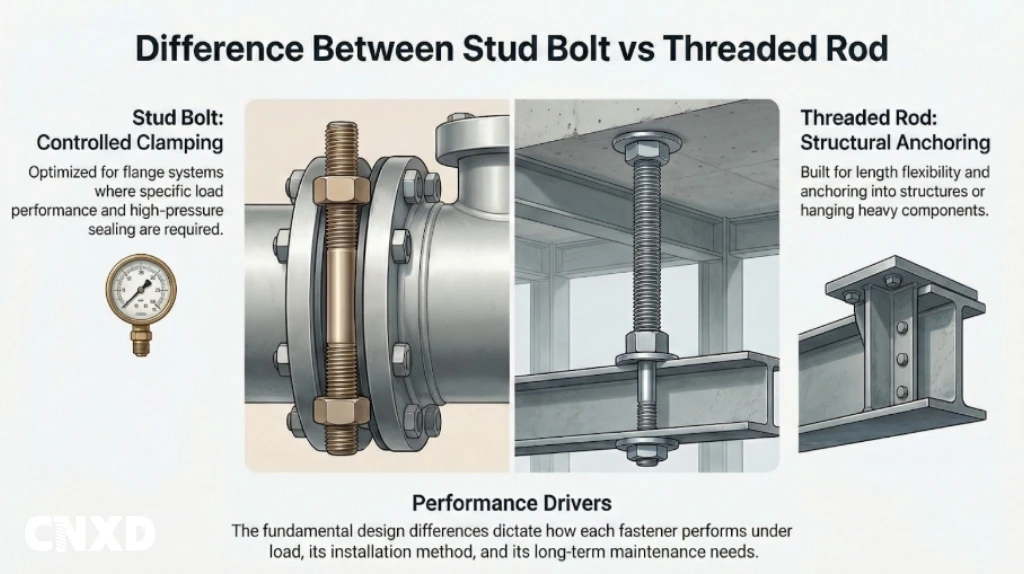
A stud bolt is designed for controlled clamping in flange systems, while a threaded rod is built for length flexibility and structural anchoring.
That single difference drives:
- How each performs under load
- How you install it, and
- How you maintain it.
If you are comparing stud bolt vs threaded rod options, your decision should be based on load type, environment, and service access.
Be careful; a wrong choice can create alignment issues, uneven preload, or long-term maintenance problems.
This guide explains the structural differences, performance impact, and practical selection factors you should evaluate.
Structural Differences Between a Stud Bolt and a Threaded Rod
Understanding physical design helps you predict its actual function.
| Evaluation Area | Stud Bolt | Threaded Rod |
| Thread Coverage | Threaded on both ends with unthreaded center shank | Continuous full-length threads |
| Load Distribution | Engagement concentrated at defined end zones | Load engagement distributed along the full length |
| Torque Consistency | More controlled and predictable preload | Depends on installation and cutting quality |
| Design Type | Threaded stud bolt with defined clamping zones | Full thread stud or threaded studding |
| End Configuration | Double-ended or single-end stud options | Typically cut ends after trimming |
| Installation Method | Nuts installed on both ends or into a tapped hole | Cut to size and secured with nuts |
| Installation Impact | Better alignment control in flange assemblies | Greater field flexibility but requires careful finishing |
| Standard Lengths | Manufactured in fixed standardized sizes | Supplied in long bars for on-site cutting |
| Dimensional Flexibility | High repeatability, limited adjustment | High flexibility for custom lengths |
| Best Use Case | Controlled clamping and gasket compression | Adjustable spans and structural applications |
Load Capacity, Stress Distribution, and Performance
Design affects mechanical behavior under tension and vibration.
Tension and Shear Performance
A stud bolt is commonly used in flange systems because it allows accurate preload control. Controlled preload improves gasket sealing and reduces leakage risk.
A threaded rod bolt can handle tension loads across long spans. However, preload consistency depends on field preparation.
In vibration-heavy environments, defined engagement in a stud bolt often provides more stable clamping.
Bending and Deflection Considerations
The threaded rod performs well in suspended applications. However, long unsupported spans may bend under load.
Buckling risk increases in vertical installations if the diameter is undersized.
Stud bolts are rarely used in long-span structural applications. They are optimized for clamped joint stability rather than structural bridging.
Corrosion and Environmental Resistance
Both fasteners are available in galvanized, coated, or stainless options.
Corrosion resistance becomes critical in marine or chemical environments. Thread damage during field cutting can reduce coating integrity.
Choosing the correct material and finish protects long-term performance.
Typical Applications and Industry Use Cases
Application context helps clarify when each fastener works best.
Stud Bolt Applications
A stud bolt is widely used in flange connections for pipelines and pressure vessels. The design allows even load distribution across gaskets.
High-temperature and high-pressure systems often rely on threaded stud bolt assemblies. Maintenance teams also prefer stud bolts because nuts can be removed without extracting the entire fastener.
Threaded Rod Applications
A threaded rod is common in structural bracing and suspended systems. It supports ceiling grids, cable trays, and HVAC components.
In concrete work, threaded rod stud solutions can be installed using epoxy adhesives.
Long threaded bolt configurations are also used in light structural reinforcement.
When They Should Not Be Substituted
Substituting a threaded rod for a flange-rated stud bolt can reduce preload accuracy.
Using a stud bolt in long-span structural bracing may limit length flexibility.
Application design should always determine the choice.
Automotive and OEM Boundary Applications
In automotive manufacturing, fastening selection becomes more sensitive due to vibration, thermal cycling, and space limitations.
Stud bolts are often used in engine, exhaust, and turbocharger assemblies where controlled preload is critical.
CNXD brings OEM customization experience in defining safe application boundaries for automotive systems.
Their expertise helps ensure that stud bolt grades, coatings, and dimensions meet vibration resistance and thermal expansion requirements in demanding vehicle environments.
This level of boundary validation is especially important when components must meet durability and compliance standards across global markets.

- This double-headed blind rivet is manufactured from high-grade stainless steel or alloy steel, offering exceptional strength, corrosion resistance and installation adaptability.
What’s the Difference Between a Stud and an Anchor
Many people confuse studs with anchor systems.
Embedded Anchors vs External Fasteners
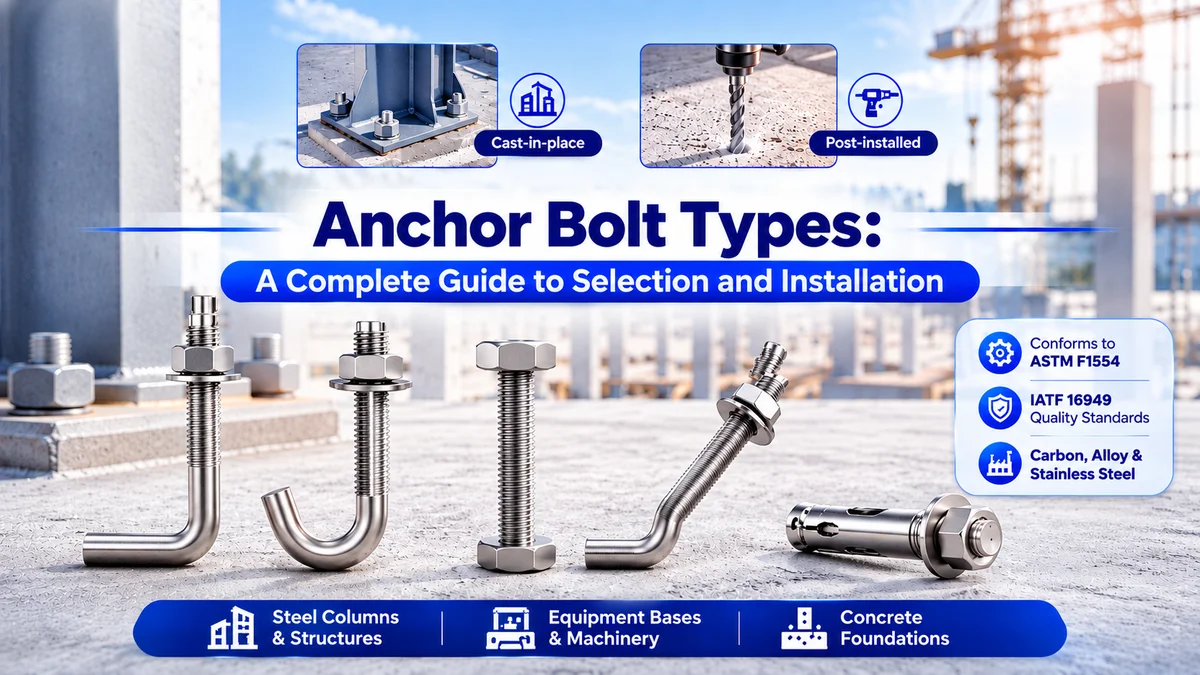
An anchor bolt is embedded into concrete to transfer the load into the structure. Mechanical and adhesive anchors rely on expansion or bonding.
A stud bolt is not embedded. It clamps components together externally.
Load transfer principles differ significantly between the two.
Threaded Rod Used as an Anchor
A threaded rod can be cut and installed with epoxy to function as an anchor. However, not all threaded rod bolt installations meet engineered anchor standards.
Proper embedment depth, adhesive selection, and inspection are critical.
Installation Differences and Practical Considerations
Ease of installation affects labor cost and reliability.
Torque Control and Nut Engagement
Stud bolt assemblies allow more predictable torque application. Engagement length is controlled during manufacturing.
Threaded rod bolt installations depend on site preparation. Cut threads must be clean to ensure proper nut engagement.
Double-nut locking methods are often used to prevent loosening.
Alignment and Assembly Efficiency
Flange systems benefit from using stud bolts because alignment is easier during assembly.
A threaded rod can be adjusted during installation, which is useful in framing systems.
Improper cutting can damage threads and slow installation.
Maintenance and Replacement
Stud bolts allow nut replacement without removing the entire fastener. An embedded threaded rod may be difficult to remove if bonded into concrete.
Maintenance planning should influence your decision.
Selection Guide: How to Choose the Right Fastener
If you are evaluating stud bolt vs threaded rod solutions, focus on these criteria.
Load Type
- Use stud bolts for high-tension clamping in flange systems.
- Use a threaded rod for suspended loads and adjustable spans.
Environment
- Outdoor exposure requires corrosion-resistant coatings.
- Chemical and marine settings often demand stainless materials.
Maintenance Requirements
- Systems needing frequent disassembly benefit from stud bolt configurations.
- Permanent structural anchoring often favors a threaded rod.
Compliance and Standards
- Review applicable ASTM and ISO material standards.
- Pressure systems may require certified threaded stud bolt grades.
- Structural applications should follow engineering design codes.
Cost and Supply Considerations
- Availability and inventory strategy also matter.
- Stud bolts are often supplied in flange kits with matched nuts.
- Threaded studding is typically stocked in long bars for flexible cutting.
- Bulk threaded rod reduces inventory complexity but may increase waste if poorly planned.
Understanding supply patterns helps you optimize purchasing decisions.
Frequently Asked Questions
1. Can a threaded rod replace a stud bolt in a flange connection?
Not recommended. A threaded rod does not provide the same controlled preload zones as a stud bolt. In pressure flange systems, this may reduce gasket sealing performance and increase leakage risk.
2. Is a stud bolt stronger than a threaded rod?
Strength depends on material grade and diameter. However, stud bolts are typically selected for controlled clamping performance, while threaded rods are chosen for length flexibility and structural support.
3. When should I choose a threaded rod instead of a stud bolt?
You should choose a threaded rod when you need adjustable length, suspended support, or anchoring into concrete. For precise flange clamping and repeatable preload, a stud bolt is usually the better choice.
Conclusion
A stud bolt is best for controlled clamping in flange assemblies, while a threaded rod provides flexibility for structural and anchoring applications.
Your selection should be driven by load behavior, installation method, and maintenance access rather than simple availability.